Elderly Smartwatch Quality Control: From PCBA Testing to Mass Production

2026-10-29

There can be issues with product mass-production, despite the prototype working perfectly during the product demonstration. There have been numerous examples of a lack of firmware testing resulting in the deployment of smartwatches with the wrong firmware, which then results in problems communicating with the server during an emergency.
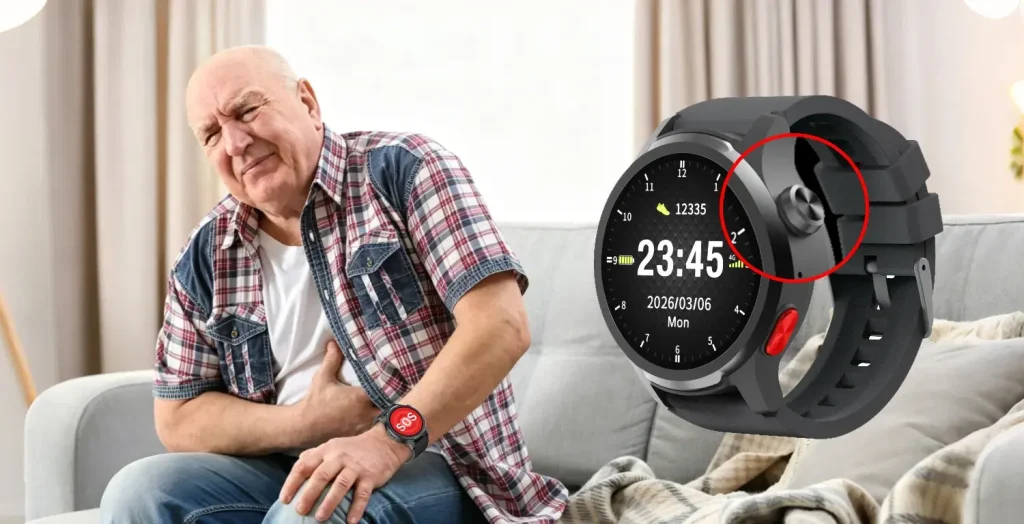
For senior safety brands, elderly smartwatch manufacturing quality control is not merely a final inspection to ensure that there are no visible product defects. It is more of a system-level inspection of the integration and interaction of the various electronic components (e.g. battery, wireless communication module, and firmware), as well as assembly.
We have extensive system-level knowledge of what drives manufacturing quality of senior safety smartwatches. Manufacturing quality of smartwatches is a combination of integration of hardware (e.g. a server, module, and watch) and software (e.g. an app and firmware). This document presents the quality check points B2B customers should look for when choosing an OEM smartwatch manufacturer.
1. Reach an Agreement on What Constitutes an Acceptable Quality of Elderly Smartwatch
Agreement on an acceptance standard should be reached before the manufacture of smartwatches.
An example of a Quality Assurance plan for a wearable device would contain:
•Hardware: PCBA revision, Cellular module, Sensors, Battery, Display
•Functional Requirements: SOS activation, 2-way calling, GPS reporting, and charging
•Firmware: Version and Language, Server address and communication protocol
•Reliability: Battery runtime, Water resistance, and Mechanical durability
•Inspections: methods and defect classification, Sampling and Traceability
Pass/ fail criteria should be determined for critical functions.
2. PCBA Testing and Electronic Component Inspection
Incoming Quality Control (IQC)
Reliable quality control occurs before assembly.
Incoming inspection should verify:
•Cellular modules and sensors against approved specs.
•Battery identification, condition and supplier.
•PCB revision and connectors.
•Electronic component traceability and engineering approved substitutions.
•Unapproved substitutions could affect the performance of the radio or firmware.
PCBA Testing During Manufacturing
Testing PCBAs before final assembly provides a last opportunity to isolate defects.
Depending on production capacity, various forms of inspections can be employed.
| Inspection Method | Primary Purpose | Potential Defects |
| SPI | Check solder paste deposition | Insufficient or excessive solder |
| AOI | Inspect component placement and soldering | Missing components, misalignment |
| ICT | Verify electrical connections | Shorts, opens |
| Functional Testing | Verify PCBA operation | Module, sensor, communication failures |
Not all inspection methods can be performed for all circuits. Buyers should confirm which inspection methods are performed and the types of failures reported.

3. Firmware Testing and Software Version Control
Hardware inspections can't prove quality for an elderly smartwatch. Features like emergency alerts, location services, and communications are firmware dependent, and so is power management.
Essential Firmware Testing Scenarios
A testing plan should evaluate firmware to:
•Verify the correct sequence and timing of SOS alerts.
•Reconnect to the network once the signal is restored.
•Capture accurate location data, device IDs and timestamps.
•Restart due to low battery.
•Send data to the server.
•Recover from firmware and behave properly during a version upgrade.
Avoid Version Control Errors
Customization of firmware for OEM projects may differ based on regional networks, servers and/or languages.
An adequate control process includes:
•Authorized firmware versions.
•Program and configure correctly according to requirements.
•Production version management.
•Traceability of version control at the serial or batch level.
•Regression testing after significant changes.
These controls help to ensure that defective smartwatches do not reach the end users.
4. Elderly Smartwatch Testing: 4G, GPS, and SOS
Elderly smartwatch testing must prioritize functions affecting emergency communication.
| Test Category | Verification Focus | Acceptance Considerations |
| 4G LTE | Network registration, data transfer | Supported bands, SIM compatibility |
| VoLTE | Incoming/outgoing voice calls | Operator and network compatibility |
| GPS | Position acquisition and reporting | Defined accuracy and reporting scenarios |
| SOS | Button, alert transmission, calling | Correct event sequence and destination |
| Audio | Microphone and speaker performance | Speech intelligibility |
| Server integration | Device-to-platform communication | Data format, identifier, timestamp |
Testing Beyond Factory Conditions
Factory tests cannot guarantee performance on every overseas mobile network.
For international projects, wearable device quality assurance should also consider:
•Destination-market LTE bands and VoLTE support.
•SIM provisioning and roaming behavior.
•Indoor versus outdoor positioning limitations.
•SOS communication under weak-network conditions.
A successful GPS test does not establish accurate indoor positioning unless the device supports and validates the relevant positioning technology.
5. Battery and Wearable Device Reliability Testing
The key considerations for testing the reliability of wearable devices are:
•Test the endurance of the battery. This involves evaluation of the run-time under various loading conditions (calling, GPS, and reporting, etc.).
•Test the reliability of charging. This involves evaluation of misalignment of charging contacts, voltage, and repeated connection.
•Test the mechanical durability of the device, e.g. button operation, and the attachment of the device to a strap.
•Assess the environmental resistance of the device. This includes the temperature tests (e.g. high and low temperature) and the vibration and impact tests.
•Check the protection of the device against water ingress. This includes testing the device against the IP rating claimed.
An IP67 or IP68 claim requires appropriate model-specific evidence. Testing one configuration does not validate another.
6. Mass Production Inspection and Quality Traceability
The uniform high quality of wearable device manufacturing requires multiple inspection stages during production.
| Production Stage | Quality Control Focus | Recommended Records |
| Incoming inspection | Component ID and conformity | Lot and supplier records |
| PCBA assembly | Defects in soldering | Inspection results |
| Firmware programming | Correct version | Firmware record |
| Final assembly | Enclosure, charging, and buttons | Inspection records |
| Testing | Functional test, calling, SOS, GPS | Functional test records |
| Pre-shipment inspection | Appearance, quantity, accessories | Inspection report |
A factory inspection should enable the buyer to distinguish between:
•Critical defects: defects that prevent a smartwatch from performing its essential emergency functions.
•Major defects: important defects in the assembly and performance of the smartwatch.
•Minor defects: defects that affect cosmetic appearances and are within accepted limits.
AQL sampling can be used for inspection of cosmetic & general defects. But some safety functions may require tighter acceptance or 100% functional testing.
Traceability connects batches of production, firmware version, hardware version, inspection results, IMEI, etc.
7. How to Audit an OEM Smartwatch Manufacturer
Before mass production, buyers should request evidence of actual manufacturing controls.
Key smartwatch quality control questions include:
•Which PCBA and finished-device tests are performed on every unit?
•How are firmware releases and component substitutions approved?
•Can SOS and communication test results be traced to individual devices?
•What happens when a production batch fails inspection?
•Which model-specific reliability reports are available?
•How are field failures investigated and corrective actions verified?
A statement of quality is fine, but a factory demonstration and documented test records are better proof.
8. OEM/ODM Elderly Smartwatch Quality Control with JiAi
JiAi provides elderly smartwatches, GPS trackers, screenless wristbands, and other connected telecare wearables for the B2B market.
As an OEM/ODM, we provide a full development scope of hardware, firmware and application integration with different communication protocols.
For every product development project, a set of quality control requirements are established in addition to product development. These include but are not limited to:
•Customized firmware/platform compatibility test.
•Acceptance tests for SOS, calling and location functions.
•Tests to verify compatibility with the regional network.
•Acceptance tests of production samples and quality documentation.
Prior to each production run, the relevant testing equipment, inspection frequency, certification and reports should be defined for the selected model.
Conclusion
Combining various controls along the supply chain is key for effective elderly smartwatch quality control. These include component verification, PCBA testing, firmware testing and communication checks, as well as traceability and control during production.
For B2B customers, selecting an OEM smartwatch manufacturer means assessing repeatable processes for manufacturing the final product, and not merely accepting a finished working prototype.
Prior to volume production, JiAi is able to align with customers to define project quality requirements and inspection mechanisms.
FAQs
Q1. How does JiAi ensure elderly smartwatch quality control?
JiAi works with OEM/ODM customers to establish quality requirements covering hardware, firmware, SOS functions, GPS tracking, 4G connectivity, and final assembly. Specific inspection procedures and acceptance criteria are confirmed for each project.
Q2. What PCBA testing methods are used for JiAi elderly smartwatches?
PCBA testing may include automated optical inspection (AOI), electrical testing, and functional verification. The actual methods depend on the smartwatch model, circuit design, and agreed production quality plan.
Q3. Does JiAi perform firmware testing before mass production?
Firmware testing can be included in JiAi's OEM/ODM quality plan to verify SOS functions, network reconnection, GPS reporting, power management, and server communication. Approved firmware versions should be verified before production release.
Q4. How does JiAi test SOS emergency functions?
JiAi can establish project-specific SOS testing requirements covering button activation, emergency alert transmission, calling sequences, audio communication, and server notifications. Acceptance criteria depend on the selected device and customized firmware.
Q5. How does JiAi verify 4G LTE and GPS performance?
JiAi's elderly smartwatch testing arrangements can include network registration, data transmission, GPS positioning, and location reporting checks. Regional LTE band compatibility, VoLTE support, and operator-specific performance require additional verification.