
4G vs Bluetooth Elderly Care Wearables: Which Connectivity Is Right for Your Project?

2026-07-29
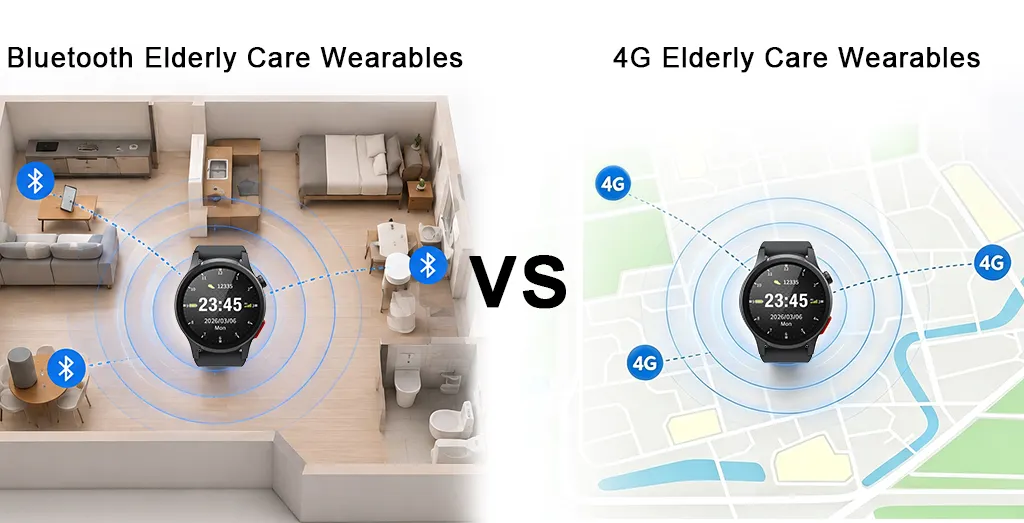
4G vs. Bluetooth Elderly Care Wearable? Choosing between 4G and Bluetooth is not simply a hardware decision. It directly affects emergency response, positioning accuracy, battery life, device size, operating costs, platform architecture, and long-term maintenance.
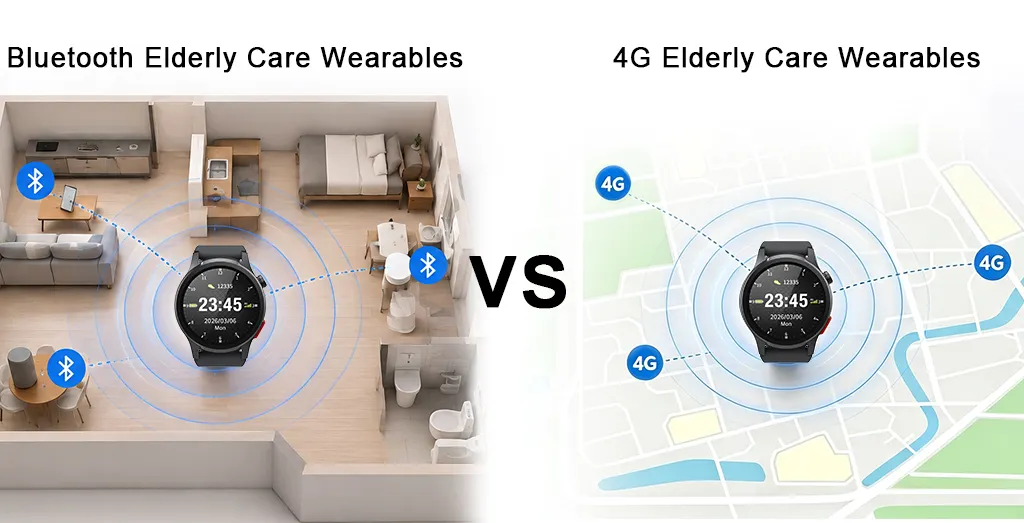
For telecare operators, nursing-home groups, healthcare platforms, distributors, and OEM/ODM brands, the correct elderly care wearable connectivity model depends on three practical questions:
•Will the wearer use the device outside a controlled facility?
•Must the wearable send SOS alerts without a nearby phone or gateway?
•Does the project require outdoor GPS tracking, indoor zone detection, or both?
When buyers compare 4G vs. Bluetooth elderly care wearables for telecare, nursing homes, GPS safety, SOS alerts, indoor positioning, battery life, platform integration, and OEM/ODM projects, they often find that neither technology is universally better. Each supports a different care environment.
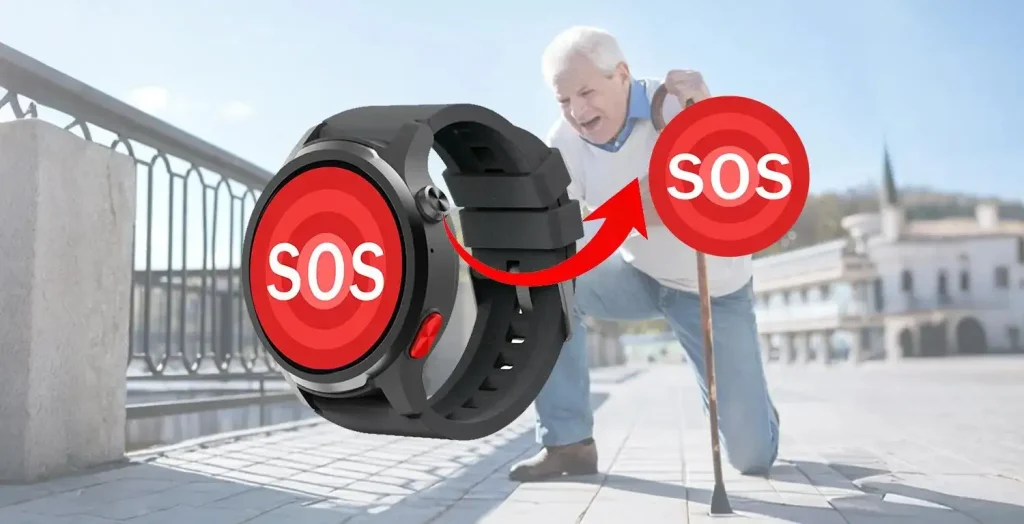
A 4G elderly smartwatch can operate independently, transmit GPS data, place emergency calls, and communicate directly with a cloud platform or private server. A Bluetooth elderly care wearable is typically lower power, more compact, and suitable for indoor applications supported by gateways, smartphones, home hubs, or BLE beacons.
What 4G Connectivity Means for Elderly Wearables
A 4G elderly care wearable uses a cellular network for data transmission and, depending on the hardware and service configuration, voice communication. It does not require a nearby smartphone, making it suitable for seniors who live independently or frequently move beyond a fixed indoor area.

Typical 4G wearable functions include:
•One-button SOS alerts
•Two-way voice calling
•GPS, Wi-Fi, and LBS positioning
•Electronic geofencing
•Low-battery and device-status alerts
•Fall-detection data transmission
•Direct communication with an app, cloud platform, or private server
This connectivity model is particularly useful for outdoor safety, dementia wandering-response programs, community care, and telecare services covering multiple locations.
Deploying a 4G device involves additional considerations and buyers must confirm:
•LTE frequency band support
•SIM/eSIM support
•APN configuration
•Compatibility with the local network operator
•Support for VoLTE
•Understanding the roaming requirements
•Signal coverage in the target market
A device supporting 4G and configured for Europe may need additional LTE bands, approvals, or firmware for North America, Australia, and other countries.
What Bluetooth and BLE Mean in Elderly Care
Bluetooth Low Energy, commonly called BLE, is designed for short-range, low-power communication. In elderly-care systems, it can connect a wearable to a smartphone, gateway, room beacon, home hub, medical sensor, or facility management platform.

BLE can support:
•Indoor zone detection
•Room and corridor identification
•Gateway-based SOS transmission
•Connection with home-care hubs
•Peripheral sensor integration
•Low-power health-data synchronization
•Exit or restricted-area alerts
Because BLE generally requires less transmission power, the wearable can often use a smaller battery and more compact enclosure. This makes Bluetooth elderly care wearables suitable for nursing homes, assisted-living facilities, rehabilitation centers, and other controlled indoor environments.
The main limitation is infrastructure dependency. A BLE wristband normally requires a nearby gateway, phone, or beacon network. Once the wearer leaves the covered area, the device may be unable to transmit an alert independently.
4G vs. Bluetooth Elderly Care Wearable Comparison
| Evaluation Area | 4G Elderly Care Wearable | Bluetooth or BLE Wearable |
| Coverage | Wide-area cellular coverage | Short-range local coverage |
| Independent operation | Yes | Usually no |
| Outdoor GPS tracking | Strong capability | Requires paired equipment |
| Indoor positioning | Limited without Wi-Fi or BLE | Strong with beacon infrastructure |
| SOS communication | Direct alert and optional calling | Routed through phone or gateway |
| Battery consumption | Higher | Lower |
| Device size | Usually larger | Can be smaller and lighter |
| Infrastructure | SIM, cellular network, server | Gateways, hubs, phones, or beacons |
| Operating cost | SIM and data-plan costs | Gateway and facility-network costs |
| Best environment | Outdoor and mixed-location care | Controlled indoor care |
This comparison shows why the 4G vs Bluetooth elderly care wearable decision should be based on the complete service workflow rather than connectivity specifications alone.
Coverage Area and User Mobility
4G is generally the stronger choice when seniors may leave their residence, care facility, or supervised area. Cellular connectivity allows the device to maintain communication across streets, parks, clinics, community centers, and other outdoor locations.
Bluetooth is more appropriate when users remain within a defined indoor environment. A properly designed gateway or beacon network can identify whether the wearer is in a bedroom, corridor, activity room, lobby, or exit zone.
SOS Alerts and Emergency Response
A 4G elderly smartwatch can send an SOS alert directly to family members, a monitoring center, or a telecare platform. It may also initiate a voice call without requiring a nearby smartphone.
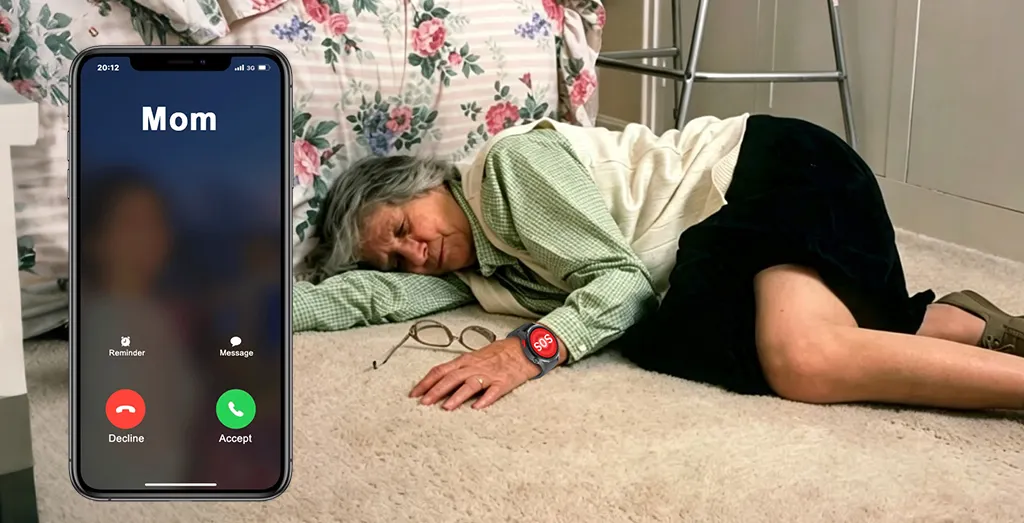
A Bluetooth wearable sends the emergency event through a paired gateway or phone. This can work effectively inside a nursing home, but the response system depends on:
•Gateway availability
•Local network stability
•Correct device pairing
•Sufficient facility coverage
•Integration with staff alert software
For high-risk users who may be alone outdoors, independent cellular communication usually provides a more resilient emergency workflow.
GPS and Indoor Positioning
4G elderly wearables commonly combine several positioning technologies:
•GPS for outdoor location
•Wi-Fi positioning for buildings and urban areas
•LBS for approximate cellular-network location
•BLE for room- or zone-level indoor detection
Bluetooth positioning works differently. BLE beacons or gateways identify proximity to a known location. This can provide useful zone information, but it should not be treated as the same as real-time outdoor GPS tracking.
Battery Life and Power Management
Bluetooth devices usually provide longer battery life because BLE communication uses short-range, low-energy transmissions.
A 4G device consumes more power due to:
•Cellular network registration
•GPS positioning
•Voice calling
•Data synchronization
•Display activity
•Frequent reporting intervals
•Weak-signal conditions
Battery specifications should therefore be tested under actual operating conditions. Buyers should define GPS frequency, standby duration, call usage, alert volume, signal quality, and charging habits before comparing devices.
Platform and Server Integration
A 4G wearable can normally send data directly to a cloud platform or customer-controlled server. This is useful for telecare projects requiring API integration, monitoring dashboards, private-server deployment, or multi-region device management.
A Bluetooth wearable device will typically follow this indirect communication path:
Wearable → Phone or Gateway → Internet → Platform or Server
This design will mean additional requirements for the deployment of gateways, device pairing, offline data caching, and the upkeep of the networks.
When 4G is the Better Option
4G is typically appropriate for:
•Elderly people living independently
•Outdoor GPS Safety Programs
•Dementia Wandering Response Services
•Telecare Services in the Community
•SOS Calling Smart Watches
•Direct to Server GPS Trackers
•Users in Multiple Locations
Key procurement considerations will be LTE bands, SIMs, antenna designs, battery, GPS reporting, the server, and certifications for the region.
When Bluetooth or BLE Is the Better Choice
Bluetooth or BLE may be more suitable for:
•Nursing homes
•Assisted-living facilities
•Indoor positioning systems
•Beacon-based zone monitoring
•Home-hub wearable systems
•Low-power safety wristbands
•Controlled rehabilitation environments
Buyers should evaluate gateway density, beacon placement, wall interference, pairing procedures, signal stability, staff maintenance requirements, and system scalability.
Why Many Projects Need a Hybrid Model
In many projects, the strongest architecture combines 4G and BLE.
A hybrid elderly care wearable can use:
•4G for outdoor communication, SOS calls, GPS tracking, and direct server access
•BLE for indoor positioning, gateway connection, accessories, and low-power sensor communication
This model is useful for seniors who move between homes, care facilities, outdoor areas, hospitals, and community services. It also gives OEM/ODM buyers greater flexibility when developing one device platform for multiple care scenarios.
OEM/ODM Considerations
Connectivity should be defined early because it influences:
•Chipset and module selection
•PCB and antenna layout
•Battery capacity
•Enclosure dimensions
•Firmware architecture
•Waterproofing design
•Server communication protocols
•Mobile app development
•Network testing
•Product certification
JiAi Intelligent Technology develops elderly smartwatches, safety wristbands, GPS trackers, SOS pendants, and telecare wearable devices for OEM and ODM projects. Existing opportunities for development include customization of firmware and BLE, 4G GPS communication, API, and other app and platform integrations. We can also explore other configurations and options regarding private server deployments.
Final Takeaway
While the number of options available is important, optimal connectivity is actually determined by the care model.
4G is best for operating independently, outdoor GPS safety, SOS calls, and wide-area server communication. Bluetooth and BLE are better for low energy, small size, indoor positioning, and gateway-based systems.
When looking at 4G versus Bluetooth elderly care wearables for telecare, nursing home and indoor positioning GPS safety with SOS alerts, as well as considering battery life, platform integration, and OEM/ODM, procurement teams should assess the entire journey of the user and the supporting infrastructure through to emergency care and the maintenance system.
In many modern elderly-care applications, 4G and Bluetooth are not competing technologies. They are complementary tools for building safer, more responsive, and more scalable wearable-care systems.
FAQs
Q1. What elderly care wearables does JiAi Intelligent Technology supply?
JiAi Intelligent Technology provides a variety of elderly care focused products including smartwatches, safety watches, wrist bands, alert bracelets, trackers, spirometer, and emergency pendants. Their products can be tailored to the needs of telecare providers, nursing residences, distributors, health care platforms, and brands for private labeling.
Q2. Does JiAi offer both 4G and Bluetooth elderly care wearables?
Yes. JiAi provides 4G GPS wearables, Bluetooth Low Energy, and hybrid 4G + BLE designs. The choice of connectivity framework is determined by the requirements for outdoor GPS tracking, SOS communications, beacons, and positioners.
Q3. Can JiAi create a hybrid 4G and BLE elderly care wearable?
Yes. In such a hybrid design, 4G can be used for wireless activities and BLE can be used for indoor accessories and beacons. JiAi can determine the integration of the necessary chipset, antennas, circuitry, and design.
Q4. Does JiAi offer OEM and ODM options?
JiAi is an OEM and ODM provider. Customization can include:
•Design and enclosure of the product
•Branding with logo and design of packaging and interfaces
•Design of SOS and alert workflows
•Alterations to the firmware
•Alterations to the intervals of GPS
•Alterations of languages
•Design and features of mobile apps
•Alterations to APIs
•Custom solutions can be offered as per cloud or private-server integration.
The extent of customization is dependent on the order size, technical viability, compliance, and timing of the project.
Q5. Can JiAi Senior Wearables integrate with a customer's platform or private server?
Yes. JiAi offers specialized consultation for API integration, interaction protocols, data field mapping, device management, and private server deployment. Prospective customers must share information regarding their platform architecture, the data they wish to collect, the alert process and flow, the security framework, and the preferred interaction protocol during the technical assessment.