
Telecare Device Integration with Monitoring Centers: Key Questions for Buyers

2026-07-31

For telecare operators, care providers, monitoring companies, and system integrators, a wearable device creates value only when its alerts and operational data reach the correct system without delay.

An elderly smartwatch, SOS pendant, GPS tracker, or home hub may generate an SOS event, fall alert, geofence warning, low-battery notification, or location update. However, if this information remains inside a standalone application or isolated cloud platform, monitoring staff may be unable to respond efficiently.
Telecare device integration with monitoring centers connects wearable devices with the operational systems used to manage users, alarms, call records, escalation procedures, and service outcomes. For B2B buyers, this capability determines whether a device can support a commercial telecare service rather than a limited product trial.
What Does Monitoring Center Integration Mean?
Telecare monitoring center integration means that device events are transferred to a platform operated by a care team, call center, central station, nursing facility, or telecare service provider.
The destination may be:
• The buyer's existing monitoring software
• A third-party telecare platform
• A private cloud or local server
• A customized elderly care data dashboard
• A central station system for smartwatches and PERS device integration
Typical data may include:
• Manual SOS events
• Fall-detection alerts
• GPS or network-based location
• Geofence entry and exit events
• Low-battery notifications
• Device offline or network-failure status
• User and device identification
• Event timestamps and acknowledgement records
The objective is to eliminate fragmented operations. Monitoring staff should not need separate systems for emergency calls, GPS information, battery warnings, and user profiles.
Device Data Is Different From a Response Workflow
Technical integration and operational response are related but separate.
Device integration answers: How does the smartwatch, pendant, tracker, or home hub send data to the monitoring center?
The response workflow answers: What happens after the alert reaches the operator?
A complete SOS alert workflow may include:
- Event generation by the wearable
- Data transmission through the mobile network
- Alert creation within the monitoring platform
- Operator acknowledgement
- Voice contact with the wearer
- Escalation to relatives, caregivers, or emergency services
- Case recording and closure
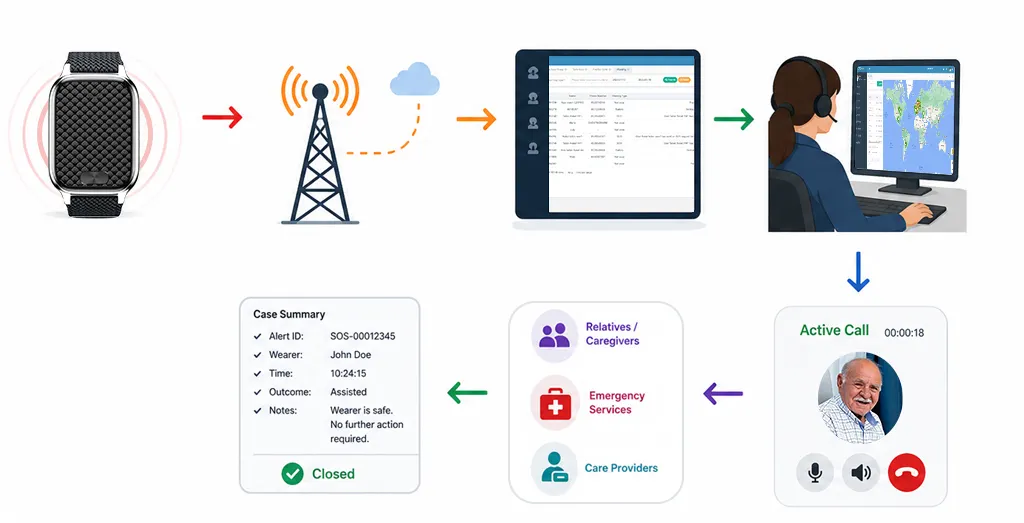
A supplier may support data communication, but the buyer must define alert priority, acknowledgement rules, escalation timing, responder responsibilities, and reporting requirements.
Key Data Types Buyers Should Confirm
Before development begins, buyers should confirm exactly which data fields can be delivered.
| Data Type | Information to Confirm | Operational Purpose |
| SOS alert | User ID, device ID, time, location and contact details | Immediate emergency response |
| GPS location | Coordinates, accuracy, history and reporting interval | Outdoor tracking and wandering response |
| Fall alert | Detection logic, cancellation period and event type | Automated risk notification |
| Device health | Battery, network, SIM, charging and offline status | Preventive maintenance |
| User profile | Care plan, facility, contacts and response instructions | Correct case handling |
SOS Alerts
SOS is normally the highest-priority event. The monitoring center should receive the wearer's identity, device number, alert time, available location, and configured emergency contacts.
Where two-way voice communication is supported, the project should also define:
• Whether the device calls automatically
• Whether the operator calls the wearer
• How unanswered calls are escalated
• Whether call status is recorded in the platform
GPS and Location Data
GPS data supports outdoor response, wandering alerts, location review, and geofence management. Buyers should confirm:
• GPS reporting interval
• Coordinate and map format
• Location-history availability
• Geofence configuration
• Accuracy information
• Behavior when GPS is unavailable
Indoor positioning may require Wi-Fi positioning, LBS, BLE beacons, or other infrastructure.
Fall Detection Events
The monitoring center should understand how fall alerts are generated, whether the wearer can cancel a false alarm, and whether fall events follow a different escalation procedure from manual SOS alerts.
Battery and Device Health
In large deployments, device-health visibility is essential. A low battery, SIM failure, offline device, weak network, or charging problem may create service risk before an emergency occurs.
Effective telecare alert management should therefore include both emergency alarms and preventive device-status notifications.
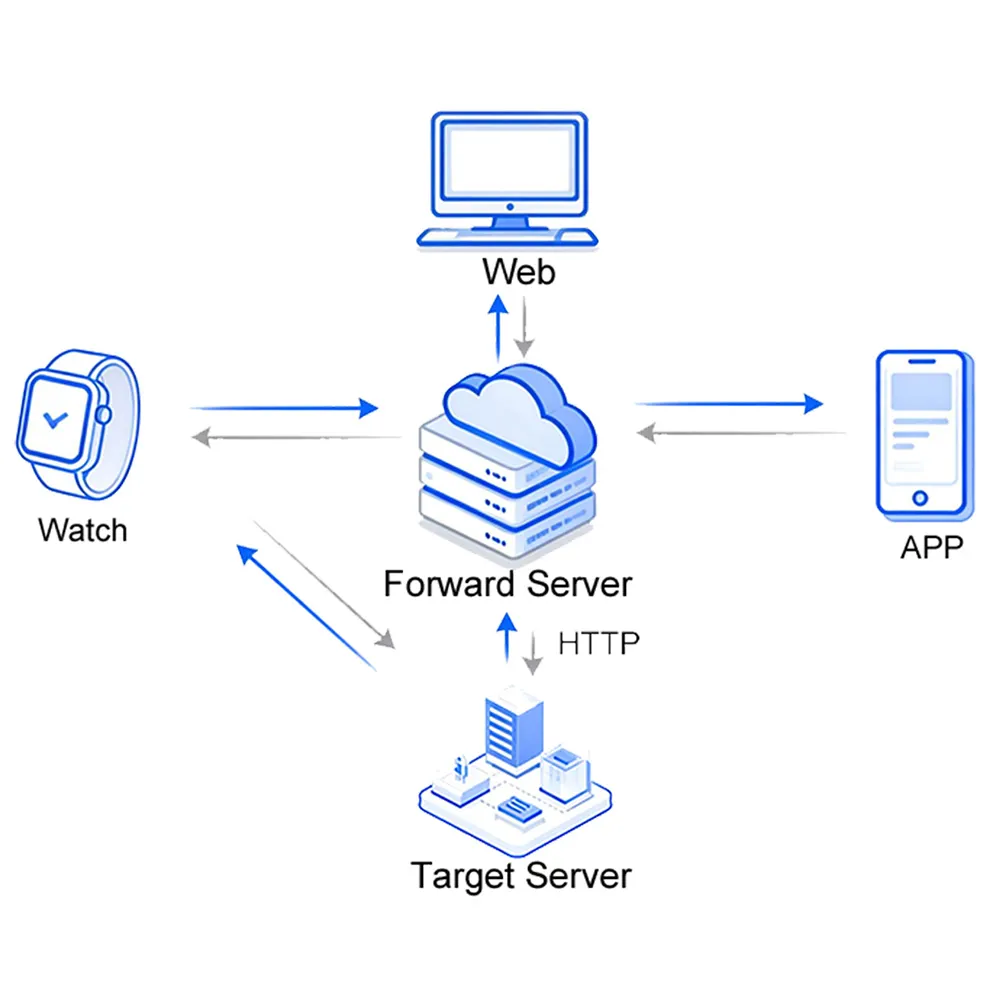
Integration Methods: API, HTTP, TCP/IP, and Private Servers
Different monitoring environments require different communication methods.
| Integration Method | Typical Application |
| REST API | Platform-to-platform data exchange |
| HTTP/HTTPS push | Direct event delivery to a customer endpoint |
| TCP/IP protocol | Persistent or protocol-specific device communication |
| Private server | Greater control over hosting, data and user accounts |
| Custom protocol | Compatibility with an existing central station platform |
When integrating PERS devices, customers should inquire:
• Are devices capable of sending events to a server of the customer's choosing directly?
• What APIs or communications protocols are available?
• What events and data fields are supported?
• Is the answer to the above questions documented and available before the commencement of development?
• Are customer-defined addresses, domains, ports, APNs, or server keys supported in the firmware?
• Can test devices connect to a staging environment?
• What is the approach to authentication, encryption and retries? What is the approach to failed transmissions?
For technical planning, see our elderly smartwatch API integration service.
User and Device Mapping
A common integration failure is transmitting an alert without a clear relationship between the device, wearer, care organization, and response plan.
A monitoring center needs more than a device number such as "A12345." Operators must know:
• Who is wearing the device
• Which facility or service provider manages the user
• Which contacts are authorized
• Which language the user speaks
• Which response instructions apply
• Whether the device has been replaced or reassigned
Before deployment, define how device IDs, user IDs, SIM numbers, organization accounts, and platform profiles will be mapped and updated.
Alert Prioritization and Display
Not every event should appear with the same priority.
A central station system for smartwatches should distinguish between:
• Critical: SOS and confirmed fall alerts
• High: Geofence exits and repeated missed check-ins
• Medium: Device offline or network failure
• Low: Low battery and routine status updates
Operators should be able to see event time, user details, location, priority, acknowledgement status, assigned responder, escalation history, and resolution status.
Pilot Testing Before Large-Scale Integration
A pilot should test the complete chain from the device to the monitoring operator. Laboratory connectivity alone is insufficient.
The pilot will need to verify the following:
• SOS delivery speed
• GPS format and accuracy
• Behavior of fall alerts
• Notifications of low battery and offline status
• Mapping of device to user
• Acknowledgment of alerts
• Escalation of alerts
• Management of weak networks
• Display and reporting of the platform
• Training of staff
The buyer can finalize the device settings, integration rules, technical documentation, and procedures for rollout after testing.
Considerations When Selecting a Telecare Device Supplier
Prior to selection, understand the answers to the following questions about the supplier:
• Which smart devices (watches, pendants, trackers), hubs, and SOS buttons can be customized?
• What events and data fields can be customized?
• What communication methods and networking options are supported? (API, HTTP, TCP/IP, Private Server.)
• Can the buyer's communication and networking protocols be supported by adapting the firmware?
• Must the test devices be customized prior to the bulk order being placed?
• How are remote configurations and over-the-air updates managed?
• What is the extent of the integration engineering support offered?
JiAi's Support for the Monitoring Center Integration
JiAi Intelligent Technology provides a wide selection of multi-functional smartwatches, health-monitoring wristbands, GPS trackers, SOS pendants, intelligent bases and other telecare devices for B2B OEM and ODM related projects.
Support can entail the customization of firmware, API, private-server evaluation, application and platform options, protocol, and custom hardware, depending on the project.
Explore our telecare device manufacturer solutions, elderly smartwatch manufacturer services, and elderly smartwatch customization capabilities.
Final Takeaway
Telecare device integration with monitoring centers connects SOS alerts, location information, fall events, device-health data, and user profiles with the systems used to manage real-world care responses.
For B2B buyers, the key question is not simply whether a wearable supports GPS or SOS. The device must deliver accurate data to the correct platform, fit the required SOS alert workflow, and scale from pilot testing to full commercial deployment.
Well-planned telecare monitoring center integration provides a stronger foundation for safer, faster, and more manageable elderly care services.
FAQs
Q1. Does JiAi provide deployment on private servers?
JiAi may provide private server solutions when customers require more management of their telecare data, user accounts, hosting, and access to the platform. This may also include the scope of the project for communication with devices, configuration of servers, documentation of APIs, application functions, and integration of systems on the customer side.
Q2. Do JiAi devices require the integration of a telecare monitoring center?
JiAi may provide telecare devices integration to monitoring centers considering the buyer's platform architecture, needed data, communication, and alarm workflow. Technical feasibility is to be validated in the project assessment phase.
Q3. What are the integration methods supported by JiAi?
Depending on the device and the project, integration may involve API, HTTP, or HTTPS communication, TCP/IP, private servers, or other tailored communication methods. The final integration support is highly dependent on the chosen hardware, firmware, and platform.
Q4. Does JiAi have the capability to route SOS events to a customer-owned/managed server?
JiAi may analyze the possibilities of firmware/server configurations that allow the devices to send SOS events to a server defined by the customer. The customer is responsible for providing the server address, port, underlying protocol, authentication, required fields, and expected rules.
Q5. What types of telecare data can be transferred to a monitoring platform?
Data that may be available include:
• SOS alerts
• Positioning via GPS or network
• Fall detection
• Geofence alerts
• Low battery
• Device offline
• Device/user ID
• Date/Time of the event
• Data of the involved activities or health
The exact data available will also depend on the device, the sensors on the device, the firmware, and the integration.