

Future-Ready Telecare Devices 2026: How Custom Wearables Will Shape Assisted Living

2026-01-23

At JiAi Intelligent Technology, we see Telecare Devices 2026 as the turning point where assisted living technology, remote monitoring, and personalized wearables converge into a single, interoperable care fabric. As operators scale beyond pilot programs and into nationwide services, the winners will be those who combine reliable hardware, device-to-cloud intelligence, and human-centered design. Off-the-shelf gadgets rarely fit complex care workflows; custom wearable telecare solutions, built by experienced OEM/ODM partners, will.
The 2026 Telecare Ecosystem: More Than an SOS Button
1) Elderly Smartwatches with SOS and Fall Detection
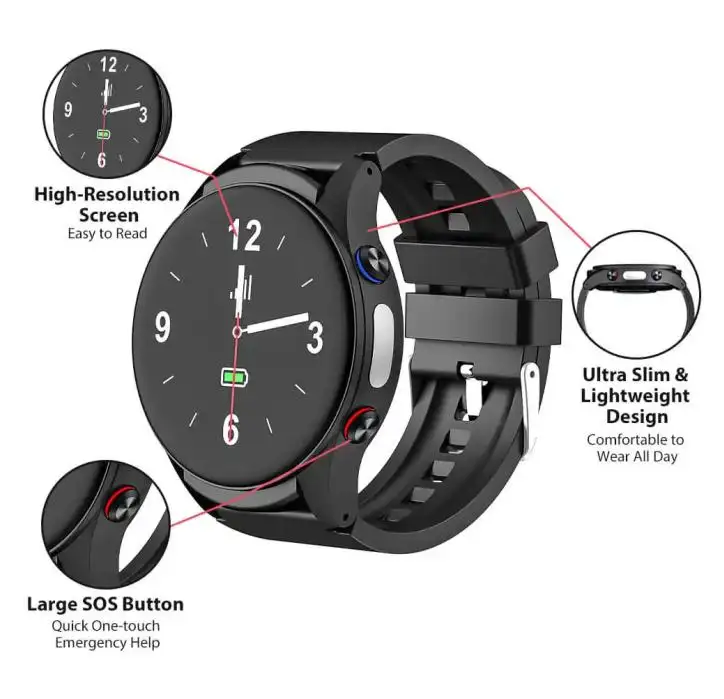
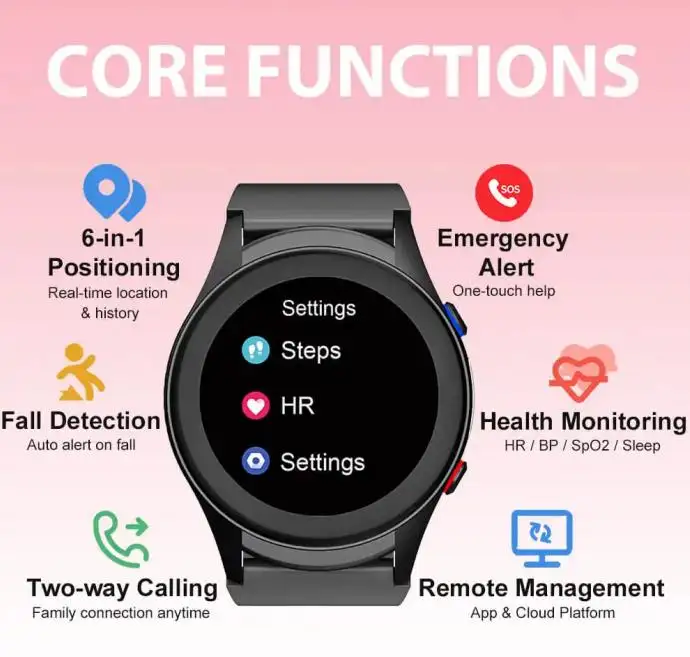
Smartwatches anchor the modern senior monitoring system, bringing daily activity tracking, heart-rate trending, fall detection, and one-touch SOS into a familiar form factor. By 2026, wearables must seamlessly connect to care platforms, enforce geofences for those at risk, and use crisp haptics and voice prompts for clarity. JiAi smartwatches combine power-savvy sensors with reliable LTE-M/NB-IoT links so caregiver notifications are instantaneous.
2)Discreet SOS Pendants for Indoor Safety
A watch isn't everyone's preference. A discreet pendant - light, refined, and easy to actuate - remains indispensable. As an SOS pendant OEM, we tune tactile feedback, optimize radio protocols, and manage beacon intervals to stay reliable across apartments, hallways, and shared areas. Anti-tamper hardware and moisture resistance ensure consistency.

3)GPS Trackers for Dementia Wandering Protection
For wandering risk, GPS devices are vital. By 2026, GPS tracker for elderly must combine accurate positioning with efficient power use, provide safe-zone geofencing and proactive alerts, and integrate with caregiver applications for rapid response. JiAi enables hybrid positioning (GPS, Wi-Fi positioning, cellular triangulation) to maintain continuity indoors and outdoors.
4) Telecare Hubs for Home Connectivity
The hub orchestrates the home: bridging BLE peripherals, pendants, and wearables to the cloud via cellular or Wi-Fi. Robust failover, local buffering, and secure pairing are vital. Our hubs support both consumer broadband and managed cellular backhaul, keeping Telecare Devices 2026 online even during network fluctuations.
5) Assisted Living Monitoring Consoles
Facility teams need a live command center. Consoles consolidate alerts, resident status, battery health, and device connectivity into a single, role-based interface. Integration with nurse call and building management systems reduces swivel-chair operations and speeds response.
6) Cloud-Based Senior Monitoring Platforms
Cloud platforms bind the ecosystem together. Standards-based APIs, event streams, and identity management maintain a unified senior monitoring system across devices, locations, and vendors. By 2026, buyers will demand seamless interoperability across all components - exactly what JiAi enables through device-to-cloud reference architectures.
Why Custom Wearables Matter in Assisted Living
1) Different Alarm Workflows: One operator escalates SOS to on-site staff; another escalates to a regional call center; a third routes events to family. Each workflow dictates firmware logic, retry behavior, and notification payloads. Policy-aligned alarms reduce false positives and satisfy clinical governance.
2)Escalation Mechanics: Risk-tiered, shift-aware, quiet hours, acknowledgements, audit-ready logs.
3) Network Fit: LTE-M/NB-IoT/2G/3G options; roaming-aware; tuned RF, modem, and transmission profiles.
4) Regulatory Map: EMC, RF exposure, safety marks, medical regulations, accessibility standards - country by country.
Mass-market gadgets cannot meet all these constraints. ODM development produces tailored wearable telecare solutions designed for real-world operations, minimizing false alerts, maximizing battery life, and improving caregiver adoption.
Trend: Discreet and Comfortable Wearables
- Elderly Users Prefer:
• Lightweight smartwatches that feel natural all day
• Elegant SOS pendants that blend into clothing and jewelry
• Hidden emergency buttons that avoid stigma
• Soft-touch, hypoallergenic materials that reduce irritation
By 2026, design-sensitive Telecare Devices 2026 will increase adoption and reduce resistance. Design that feels like care. Management that scales like IT.
• Enclosures tailored to brand and comfort
• Hypoallergenic elastomers; satin/brushed metals
• Form, strap, and button ergonomics for dexterity/vision
- Platform-Driven Device Management:
• Remote provisioning
• OTA firmware/security updates
• Battery health monitoring
• Fleet dashboards across sites
• Integration you can build on:
- MQTT/HTTP APIs
• Cloud event streams, webhooks, digital twins
• Middleware for policy control, telemetry, and alert routing
• JiAi provides end-to-end device-to-cloud integration with SDKs, staging, and reference connectors to launch faster and smoother.
Trend: Global Telecare, Locally Compliant
Telecare is expanding worldwide, but real impact comes from solutions that feel local and meet local rules. The guiding principle is to design for regional networks, regulations, and user expectations from day one, so deployments are reliable, lawful, and trusted.
- RF-tuned Hardware and Regional LTE SKUs
RF-optimized hardware paired with locale-specific LTE SKUs matches national bands, transmit-power policies, and carrier configurations - leading to fewer drops, quicker certifications, and consistent performance in dense city buildings and remote coverage gaps.
- SIM/ESIM/Private APN Strategies Compliant with Local Data Rules
Provisioning uses flexible SIM/eSIM and private APNs to keep traffic separate, enforce access and retention policies, and satisfy local data regulations. Adherence to data residency, lawful intercept, emergency routing, and GDPR-level privacy is built in, with encryption, IMEI/IMSI access controls, and managed roaming compliant with national restrictions.
- CE, UKCA, FCC, and National Certifications
All units are properly marked and certified, having passed EMC, RF, safety, and, where required, medical assessments. Country-specific type approvals and lab tests are completed to minimize deployment risk and unlock public and enterprise procurement.
- Performance-Driven Localization Across Firmware, Apps, and Docs
Translation plus adaptation: firmware reflects local care routines, apps deliver inclusive experiences, and documentation aligns to national standards - reducing friction and error.
- JiAi ODM Case in the EU
The JiAi ODM partnership enabled a five-month rollout across twelve EU sites. Night quiet-hour profiles lowered disruptions, tiered alarm logic escalated intelligently, real-time APIs bridged to clinical systems, and localized packaging smoothed onboarding - resulting in faster responses and fewer false alarms.
Why OEM/ODM Telecare Partners Will Win in 2026
| Key Requirement | Role of OEM/ODM Telecare Partner |
| Custom Workflows | Regionalized workflows with policy-driven firmware and user flows that reflect local duty-of-care and escalation rules |
| Reliable Hardware | Hardware designs optimized for diverse RF environments and telecom bands, validated through in-house labs and real-world field trials |
| Regulatory & Certification Readiness | Multi-region compliance covering CE, FCC, country-specific certifications, and readiness for upcoming EU regulatory updates by 2026 |
| Scalability | Mature manufacturing capacity and process control to support multi-country rollouts with consistent product quality |
| Long-Term Product Support | Global OTA infrastructure, proactive security patching, and full lifecycle support across regions |
| System Integration | Interoperability with telecare platforms and cloud ecosystems via MQTT/HTTP APIs, webhooks, and digital twin frameworks |
| Cost Control | BOM engineering and manufacturing optimization to sustain cost-effective deployments across diverse markets |
| Supply Chain Stability | Resilient global supply chain with qualified alternative components, regional assembly options, and robust logistics planning |
| Localization Capability | Per-country language, accessibility features, and network profiles (LTE-M, NB-IoT, 2G/3G, eSIM/roaming) tailored to local standards |
| Data Security & Privacy | Data handling aligned with GDPR and local healthcare/privacy regulations, supported by end-to-end security measures |
Why JiAi:
• Senior Smartwatches: Fall detection powered by edge sensing, clear activity trends for caregivers, and voice SOS with reliable two-way audio - designed for comfort, simplicity, and daily wear.
• SOS Pendants: One-press aid, discreet feedback, water-safe, multi-day power.
• GPS Wearables: Multi-constellation accuracy, smart geofences, extended battery life.
• Hubs/Consoles: LTE/LTE-M/NB-IoT/Wi-Fi/Ethernet, backup power, auto failover, remote maintenance.
• OEM/ODM + Security: Custom hardware/firmware/UX with signed OTA, patching, SBOMs.
• Interoperable for 2026: Open APIs (FHIR/HL7, MQTT, webhooks), compliance and eSIM ready.
Conclusion
Telecare in 2026 will be defined by connectivity, customization, and comfort. Operators who partner with experienced OEM/ODM wearable manufacturers will lead the assisted living revolution - deploying solutions that fit local workflows, scale across regions, and delight residents. JiAi Intelligent Technology is ready to co-create future-ready wearable telecare solutions for global care providers, integrating devices, hubs, and platforms into one cohesive senior monitoring system.